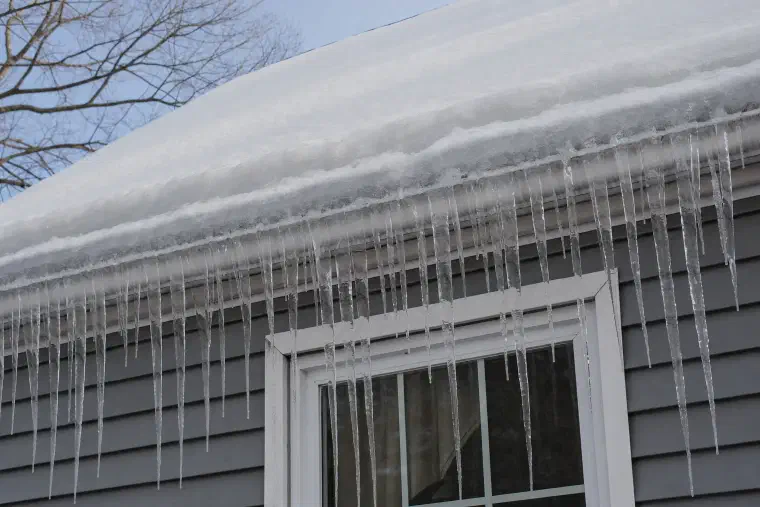
An ice dam is a ridge of ice along the lower edge of a roof that holds melting snow back until the water finds its way under the shingles and into the house. You prevent most of them by keeping the whole roof as cold as the air outside: seal the gaps that let warm air into the attic, insulate it well, and vent the space under the roof. Clean gutters and a roof rake used from the ground help with the rest.
The ice is outside, but the cause is inside.
What causes ice dams
Three things have to happen at once, according to Building Science Corporation: snow on the roof, air outside below freezing, and roof boards under that snow that are warmer than freezing.
The warmth comes mostly from the house. Heated air leaks up into the attic through gaps around ceiling lights, the attic hatch, pipes, wires and the chimney, and more heat passes through insulation that is thin or patchy. That warms the roof boards, and the snow on top of them melts from underneath. University of Minnesota Extension says air leaking into the attic is the main way that heat gets there in many homes.
The meltwater runs down the roof under the snow until it reaches the overhang. That strip of roof sticks out past the warm walls of the house, so it stays cold, and the water freezes there. Every round of melting adds another layer. In time the ridge of ice holds back a pool of water, and the Insurance Institute for Business and Home Safety (IBHS) explains that the growing dam can force that water under the shingles, and from there into the attic or down inside the walls.
Gutters packed with leaves make it worse. A gutter that freezes solid gives meltwater nowhere to drain, so the ice fills the gutter, backs up onto the roof edge, and its weight drags the gutter away from the house.
Why roofs around Scranton get them
A Scranton winter brings heavy, wet snow and long runs of freezing and thawing, and that suits ice dams. North Dakota State University Extension notes they are most common when snow is on the roof, heat is being lost through it, and the temperature outside sits just below freezing.
Up out of the valley, there is more of it. Moscow, Dallas, Mountain Top, White Haven and Hazleton, which sits around 1,600 feet up, are on higher ground, where winter brings more snow and it stays on the roof longer. Snow works like a blanket. Building Science Corporation points out that a deep layer traps heat against the roof boards, so more snow means more ice damming.
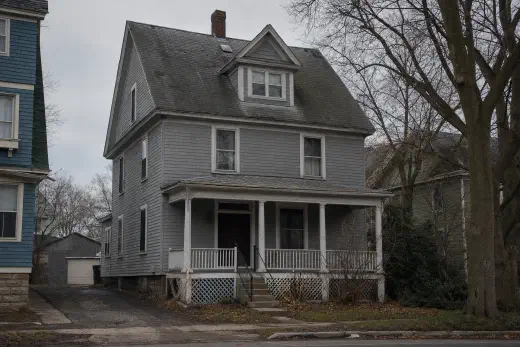
Then there are the houses. Many Scranton homes date from the late 1800s and early 1900s, with steep roofs, dormers and a chimney rising through the middle of the attic. Plenty have solid soffits, the boards under the roof overhang, with no vents in them at all, or vents buried under insulation from the inside. University of Minnesota Extension lists roofs with lots of angles, recessed ceiling lights, skylights and heating ducts in the attic among the things that raise the risk.
Signs you have one, or soon will
Worry when you see any of these, and more so when you see several:
- A thick band of ice along the roof edge, with icicles hanging along the whole length of the gutter, winter after winter. A few small icicles after a sunny day are normal: Building Science Corporation notes that snow melted by the sun makes small icicles that do not back water up.
- Snow melting off the roof in patches, or faster than on the houses next door, on a day that stays below freezing.
- Gutters full of ice, or sagging and pulling away under the weight.
- Brown stains on ceilings or at the tops of outside walls, most often upstairs, close to the roof edge.
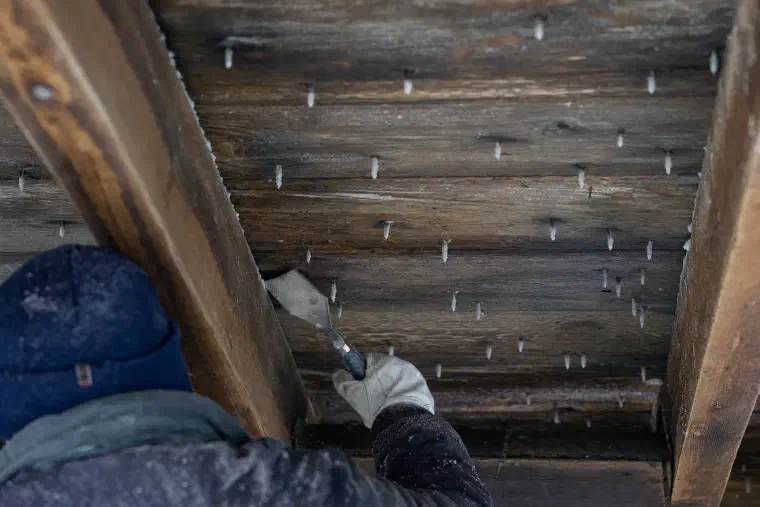
- Trouble in the attic: frost on the nail tips poking through the roof boards on a cold morning, damp or matted insulation at the low edge of the roof, or dark stains on the wood. A Department of Energy guide to durable attics lists wet insulation near the eaves among the signs that water is getting in.
How to prevent ice dams, from the attic out
Each fix below works on one part of the problem. They are roughly in order of how much they do, starting where the problem starts.
1. Seal the warm-air leaks, then add insulation
This matters most. Building Science Corporation puts it plainly: stopping air from leaking into the attic matters more than how much insulation is up there, but both are important. University of Minnesota Extension gives the same order: first make the ceiling airtight, so no warm, moist air can flow from the house into the attic, then think about adding insulation.
The usual leaks are the gaps around ceiling lights, the attic hatch or pull-down stairs, plumbing and wiring holes, the chimney, and bathroom or kitchen fans. A fan that blows into the attic instead of outdoors pours warm, damp air right where you do not want it. Insulation needs to run all the way out to the low corners over the outside walls, where it is often thinnest. When we look at an attic for venting work, we will tell you if sealing or insulation needs attention too.
2. Balance the venting: air in low, out high
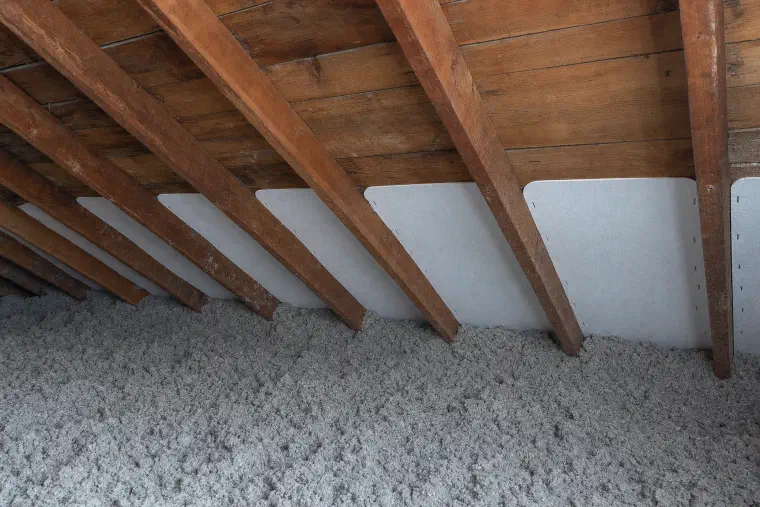
Venting carries off the heat that still gets through. Cold air comes in through vents in the soffits, runs up along the underside of the roof boards, and leaves through a ridge vent along the peak. Baffles fitted between the rafters at the roof edge hold the insulation back, so it cannot smother the soffit vents. The Department of Energy attic guide recommends the same setup.
More vents are not always better. Mixing a ridge vent with box or gable vents on the same roof lets them draw air from one another rather than through the soffits. University of Minnesota Extension advises against powered attic fans as an ice dam fix, since they can cause other moisture problems and pull air out of the house. And venting cannot make up for a leaky ceiling, which is why it comes second. We put in soffit and ridge venting, and we fix vents that are blocked, leaking or working against each other.
3. Clear the gutters and downspouts before the first hard freeze
Around here, that means a cleaning after the last leaves come down and before the ground freezes. A winter checklist from the Pennsylvania Insurance Department says the same: clear out the leaves and sticks so melting snow and ice can flow freely. Check the downspouts too, since a clogged bend freezes as solid as a full gutter, and look for sagging runs and loose hangers: a gutter that sits flat holds water, and that water turns to ice. We do gutter cleaning with the downspouts flushed, and gutter repair for runs that sag.
4. Rake snow off the lower roof from the ground
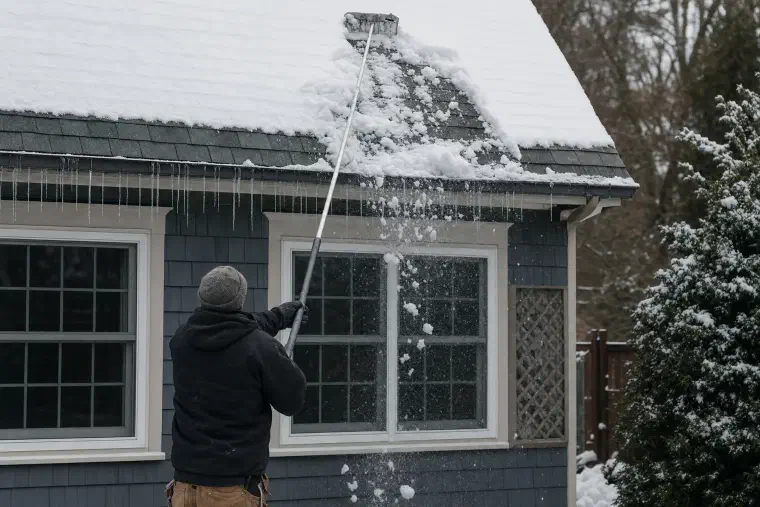
After a heavy snow, pull the snow off the lower part of the roof with a roof rake, standing on the ground. North Dakota State University Extension explains why it works: with the snow gone from the lower roof, there is nothing up there to melt and feed the ice by the gutter. IBHS suggests a rake with small wheels, which keep the blade off the shingles, and warns to stay well clear of the power lines coming into the house. University of Minnesota Extension adds that a rake can still damage the roofing, so go gently. If your roof edge is low enough to reach from the ground, a roof rake is worth having.
5. At the next new roof, protect the edge
A new roof will not fix a warm attic, but it is the best chance to get two things right. The first is the venting: with the old shingles off and the ridge open, cutting in a ridge vent is easier than it will ever be again.
The second is the edge itself, so ask what goes under the shingles along the bottom of the roof. An ice barrier, a self-sticking waterproof sheet laid on the roof boards along the eaves, does not stop ice from forming, but it helps keep water that backs up behind the ice out of the house. Building Science Corporation says the same of these sheets: they do not prevent the ice dam, they only limit the damage.
Or think about metal. On a steep roof, snow slides off metal before it can melt and freeze again at the edge, and Building Science Corporation notes that older buildings in New England use metal for exactly that reason. We put on new roofs in shingles or metal, and we can price both side by side.
Do heat cables or gutter guards stop ice dams?
People ask what they can put on the roof to stop ice dams. Here is how the usual answers compare with the fixes above:
| What people try | Does it stop ice dams? |
|---|---|
| Sealing gaps and adding insulation | Yes. It keeps house heat out of the attic, which is the cause. |
| Soffit and ridge venting | Yes, together with sealing. It carries off the heat that gets through. |
| Clearing gutters before the freeze | It helps. Meltwater has a way off the roof. |
| A roof rake | For that snowfall. With the snow gone, there is nothing to melt. |
| Heat cables | No. They melt a path for water through the ice. |
| Gutter guards | No. They keep leaves out of the gutter. |
| An ice barrier under new shingles | No. It helps keep backed-up water out of the house. |
| A metal roof | It helps on a steep roof, where snow slides off. |
Heat cables are electric wires run in a zigzag along the roof edge and through the gutters and downspouts. IBHS says they will not remove an ice dam, but they can keep channels open so water drains off safely, and it advises professionally installed, high-quality cables with a safety listing such as UL. Where they help is in keeping a path open in a gutter or downspout that keeps freezing. They treat the ice, not the heat that makes it: North Dakota State University Extension says homeowners too often reach for heat tape instead of preventing the problem in the first place.
Gutter guards do not stop ice dams either. The ice forms on the roof, above the gutter, from the heat underneath, and snow can sit on top of a guard until it melts. What a guard does is keep leaves out, so the gutter is not frozen solid with them and the meltwater has somewhere to go. That is the job we put gutter guards in to do, and it is all we claim for them.
Already have an ice dam? What is safe to do now
Safe ice dam removal is mostly about what not to do. Stay off the roof. Building Science Corporation notes that people die every year when big ice dams fall on them, or when they fall off roofs trying to get rid of them, and University of Minnesota Extension warns that working on a winter roof, even from below, risks injury and damage to the house. Here is what you can do:
- Rake the snow off the lower roof from the ground, above the ice, so less meltwater feeds it. Stand back from the edge, where ice and snow can come down without warning.
- Do not chip, hammer or pry at the ice. It is easy to break shingles and gutters that way, and Building Science Corporation warns that hacking away at an ice dam damages the roof.
- Do not throw rock salt on the roof. Iowa State University Extension warns that rock salt is highly corrosive and can damage plants, and from a roof it washes straight into the metal gutters and the garden beds below.
- Inside, catch the water. Put a bucket under any drip, move what you can out of the way, keep out from under a ceiling that sags, and if water is coming through a light, shut off its power at the breaker.
- Take photos of the ice outside and the damage inside before anything is moved.
If water is coming inside, call our emergency line at (570) 413-3082, any hour. Our emergency roof repair starts by stopping the water, and the lasting fix comes once the roof is clear. Inside, wait: University of Minnesota Extension advises repairing ceilings and walls only once they are dry, and fixing the heat loss that caused the dam at the same time, or the damage comes back. When it is time, we can handle the roof repair and the stained or soft drywall both.
Will homeowners insurance cover ice dam damage?
It depends on your policy, and only your insurer can say for sure. The Pennsylvania Insurance Department, in its winter guide, says standard homeowner policies cover winter damage such as ice damming, and in the same breath tells homeowners to keep their property well maintained so a claim is never needed. Your own policy is what decides your claim, so read it, and call your agent before you count on anything.
If you do file a claim, the department advises:
- Call your insurance company right away, and follow what the claims staff tell you.
- Photograph the damage inside and outside, and take notes on every call.
- Make only temporary repairs until the adjuster has seen it. Permanent repairs before the inspection could get the claim denied.
- Keep damaged things until the adjuster says you can throw them away.
- Get more than one estimate, check references, and get everything in writing.
Our photos and written quote are yours to send to your insurer.
Questions homeowners ask
Will a metal roof stop ice dams?
On a steep roof it goes a long way, since the snow slides off before it can build ice at the edge. It does nothing about heat leaking into the attic, though, and a roof full of snow letting go at once lands hard, so plan where it will fall: away from doors, walkways and decks.
Should the whole roof get ice and water shield?
It will not prevent ice dams. Ice and water shield is the self-sticking waterproof sheet described above, and it does not stop ice from forming; it helps keep backed-up water out of the house. Along the lower edge, where ice dams form, that backup makes sense. Over the whole roof, the money does more good in the attic.
Can ice dams damage shingles?
Yes. Water held behind the ice is forced up under the shingles, the weight of the ice pulls on the roof edge and the gutters, and chipping at it breaks the shingles it is frozen to. The Department of Energy attic guide lists worn or warped shingles at the roof edge among the signs that water has been getting in.
Does raking the roof prevent ice dams?
It helps, one snowfall at a time. Clearing the lower roof takes away the snow that would melt into the ice, but raking does nothing about the heat, so every big storm means raking again. Think of it as upkeep until the attic is fixed.
Are roofers responsible for ice dams?
Not for the ice itself. An ice dam comes from snow, cold air and heat escaping from the house, and most of that heat reaches the attic through gaps and thin spots in the ceiling below it. A roofer does answer for the work: how the roof edge was built, the metal sealing the joints around chimneys and vents, and any vents they put in. If a roof that went on recently leaks at the edge in its first winter, call the company that did the work and ask them to look. Your contract and any warranty set out what they owe you.
Have the attic and roof edge looked at before the snow
Fall is the time, before snow covers the roof edge. We will look at the roof edge, the gutters and the attic venting, and show you photos of what we find. If sealing or insulation is the bigger problem, we will tell you that too. The look and the quote are free. Ask for a free look, text us a photo of your roof edge, or read more about attic venting installation first.